Introduction
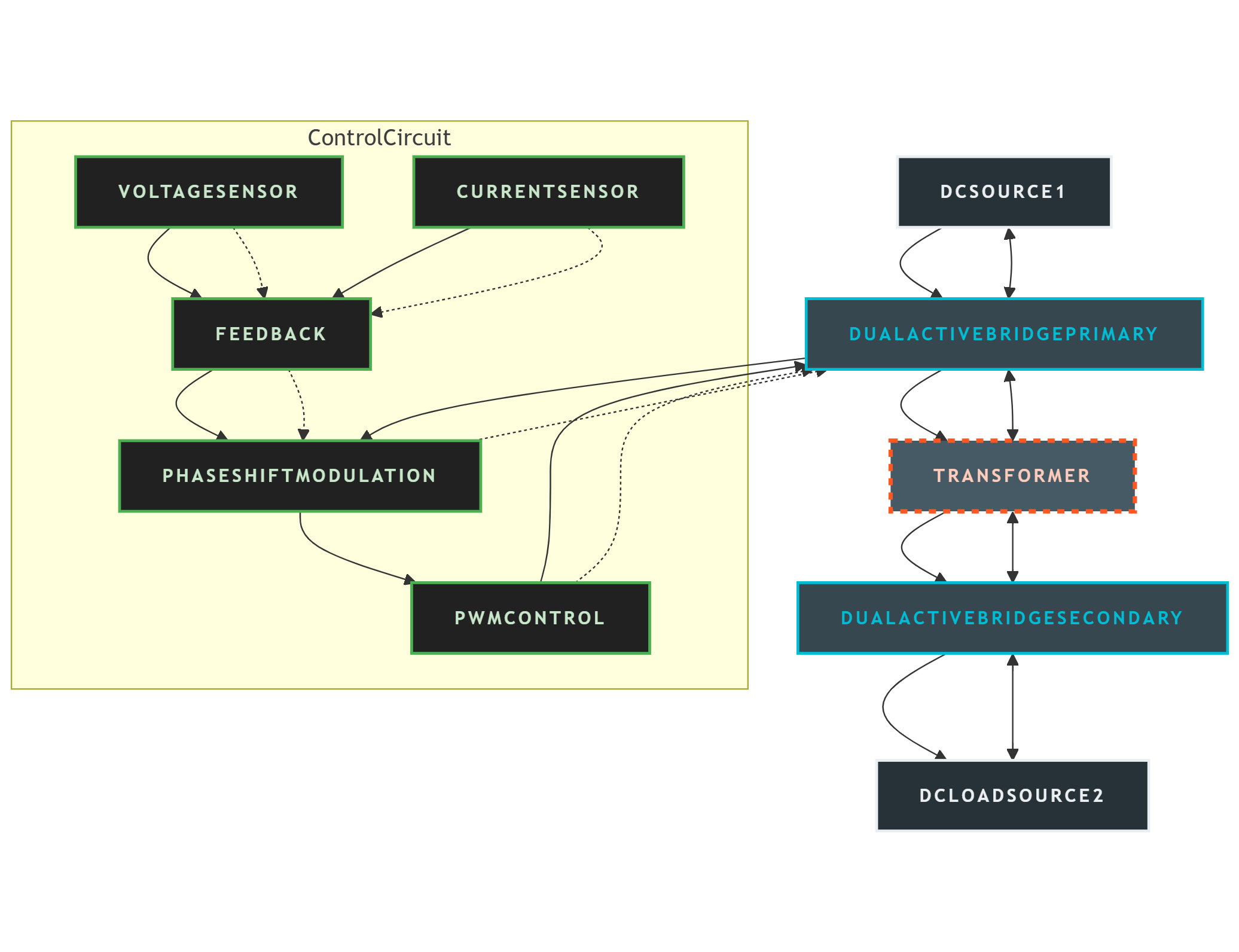
This project focuses on the design and implementation of a bidirectional dual active bridge (DAB) DC-DC converter optimized for aerospace applications. The DAB topology offers galvanic isolation, high efficiency, bidirectional power flow, and compact size, which are critical for aerospace power systems. With soft-switching and high-frequency operation, the converter achieves excellent power density and reliability, suitable for onboard energy management in aerospace vehicles.
Objectives
- To design a bidirectional dual active bridge converter tailored for aerospace power requirements.
- To maximize efficiency using soft-switching techniques and high-frequency operation.
- To ensure galvanic isolation between voltage domains for safety and noise reduction.
- To validate performance under typical aerospace load and environmental conditions.
Methodologies
- Study of DAB converter topology and aerospace power system requirements.
- Mathematical modeling and simulation of converter operation and control strategies.
- Design of hardware prototype with SiC MOSFETs and planar transformers for high frequency.
- Experimental testing focusing on efficiency, power density, thermal management, and reliability.
Expected Outcomes
- A space-grade bidirectional dual active bridge converter with efficiencies exceeding 97%.
- Compact and lightweight power module with high power density > 2 kW/L.
- Bidirectional power flow suitable for energy storage and distribution in aerospace systems.
- Demonstration of soft-switching operation minimizing losses and EMI.
Applications
- Power management systems in aircraft and spacecraft.
- Battery charging/discharging and energy storage in aerospace platforms.
- Fuel cell and renewable power integration onboard aerospace vehicles.
- High-performance DC power distribution with isolation and bidirectional control.