
Introduction
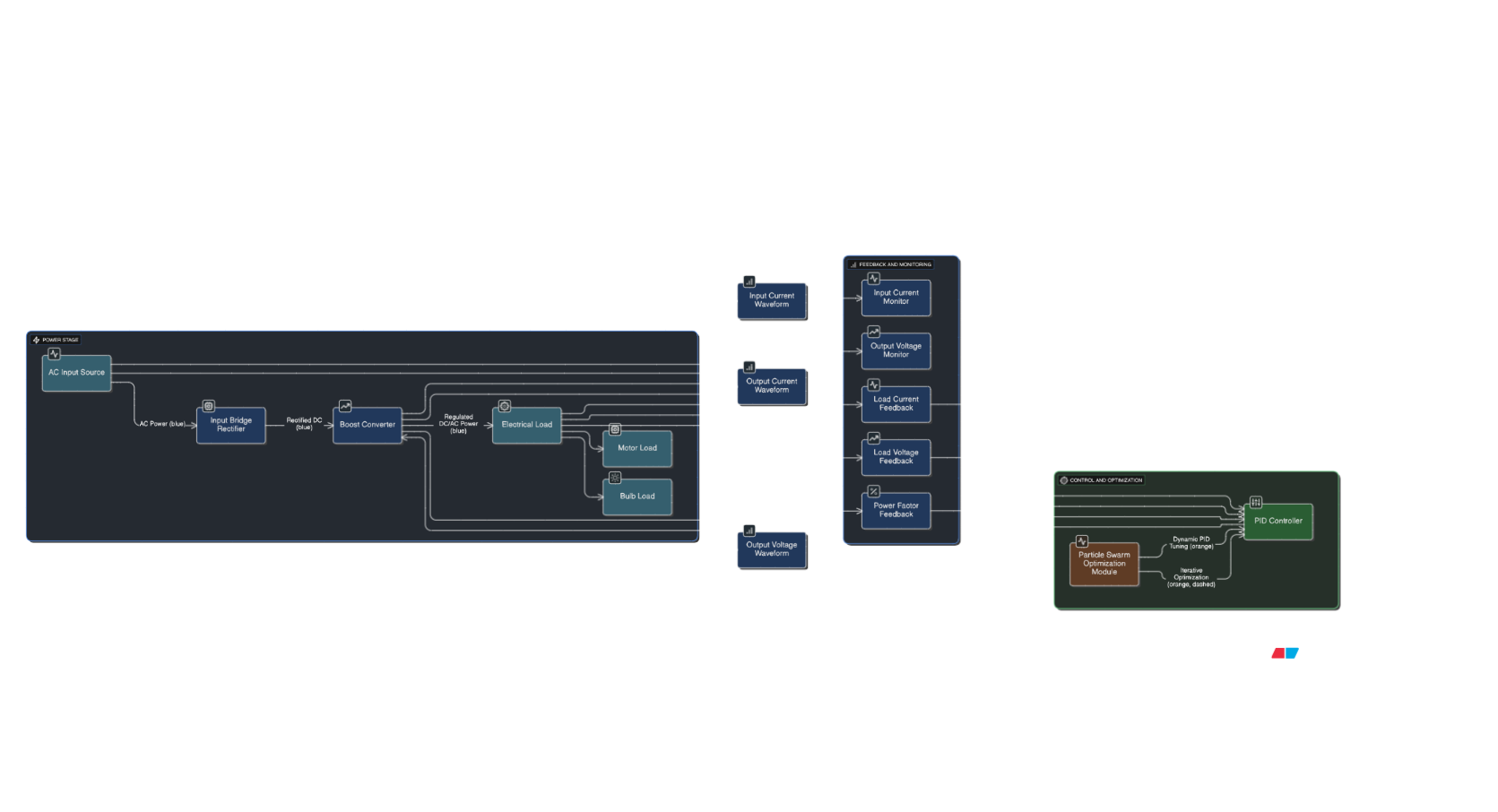
The design and implementation of a power factor correction (PFC) system using a boost converter controlled with a PID (Proportional, Integral, Derivative) controller optimized by Particle Swarm Optimization (PSO) algorithm. Traditional PID controllers require manual tuning, but PSO automates this process to achieve better transient response and steady-state accuracy. The boost converter shapes the input current to minimize harmonic distortion and improve power quality, making it suitable for both industrial and commercial power systems.
Objectives
- To develop a boost converter-based power factor correction system.
- To implement a PID controller with parameters optimized using the Particle Swarm Optimization algorithm.
- To achieve near unity power factor and low total harmonic distortion (THD) in the input current.
- To validate control performance via simulation and experimental setup.
Methodologies
- Design of the boost converter PFC circuit with input bridge rectifier.
- Development of PID control algorithm for regulating input current and output voltage.
- Application of PSO algorithm to optimize PID parameters for optimal performance.
- Modeling and simulation using MATLAB/Simulink.
- Hardware prototype development and testing for controller validation.
Expected Outcomes
- Improved dynamic response and stability of the PFC system through PSO-optimized PID control.
- Reduced harmonic distortion and improved power factor approaching unity.
- Enhanced efficiency and reliability of the boost converter PFC system.
- Validation of simulation results through practical hardware experiments.
Applications
- Power factor correction in industrial and commercial power supplies.
- Renewable energy systems requiring stable and efficient power conversion.
- Electric vehicle chargers and other high-power electronic equipment.
- Grid-interfaced power electronics requiring harmonic mitigation.